
When a foreign worker leaves Vietnam, the financial penalty for a botched offboarding lands on the company, not the employee. An enterprise that fails to revoke a work permit on time can face administrative fines of VND 30 to 75 million, and a record of non-compliance can suspend its right to sponsor new foreign hires altogether. The exit procedures for foreign employees in Vietnam run across four state agencies at once, each with its own deadline, and a delay in one stalls the others.
This guide maps the full statutory sequence under the framework current through 2026: the Labor Code 2019, Decree 219/2025/ND-CP on foreign workers, the Law on Social Insurance 2024, and the Law on Tax Administration. It is written for HR, legal and finance teams at FDI companies who need a defensible offboarding protocol. For the social insurance step specifically, departing foreign staff retain a valuable right that Vietnamese nationals are losing, covered in detail in section five. Learn more about how terra supports compliant HR and payroll operations at terra.
| Question | Answer |
|---|---|
| How long to settle final pay? | Within 14 working days of termination; up to 30 days only in defined cases (Article 48, Labor Code 2019). |
| When must the work permit be revoked? | The employer submits the revocation dossier within 15 days of termination under Decree 219/2025/ND-CP. |
| How long is the exit visa? | Typically a short stay of 14 days to finalize affairs and depart. |
| PIT finalization deadline? | Within 45 days of the departure date for an individual finalizing directly. |
| Can a foreigner withdraw social insurance? | Yes. The one-time social insurance claim for foreigners is preserved under the Law on Social Insurance 2024, even as the rule tightens for Vietnamese nationals. |
What are the mandatory exit procedures for Foreign Employees in Vietnam? (2026 legal framework)
Foreign employees leaving Vietnam must complete work permit, labor contract, tax, social insurance, and immigration-related exit procedures to ensure full compliance with Vietnamese employment laws and avoid penalties for both the employer and employee.

Step-by-Step Guide: How to execute exit procedures for foreign employees compliantly
Ensure a smooth and legally compliant transition when parting ways with international team members. Here is your step-by-step roadmap to handling work permits, visas, and tax clearances properly.
Settle the final payment and severance
The first obligation after termination is to close out every financial right between the company and the worker. To terminate the employment contract of a foreign worker in Vietnam cleanly, the employer must clear wages, severance, unused leave and any contractual bonuses within a fixed statutory window, or risk a labor dispute.
The 14-day settlement rule and its exceptions
Under Article 48 of the Labor Code 2019, both parties must settle all financial obligations within 14 days of the official termination date. The law allows an extension to a maximum of 30 days only in narrow cases: the employer ceasing operations, restructuring, a merger or consolidation, or force majeure such as a natural disaster or fire. Outside these, missing the 14-day window is a labor violation that exposes the company to late-payment interest and administrative fines from the local Department of Home Affairs, which now absorbs the former DOLISA labor functions.
Severance allowance for foreign workers
A foreign employee who worked regularly for 12 months or more is entitled to a severance allowance. The formula is half a month of salary for each full year of service, based on the average contractual salary of the six consecutive months before termination. Because foreign workers do not participate in Vietnam’s unemployment insurance scheme, the employer carries the full severance cost for the entire tenure, with no offset for unemployment insurance periods.
Unused annual leave and pro-rated bonuses
The final settlement must also pay out untaken statutory annual leave, calculated on the employee’s daily wage at termination. If the contract or internal labor rules promise pro-rated performance bonuses, housing allowance or relocation support on exit, those amounts belong in the final liquidation minute and must be paid in full. A common failure point: companies settle salary on time but forget accrued leave, which reopens the dispute window.
Revoke the work permit and cancel the residence card
A foreign national’s right to work and live in Vietnam rests on company sponsorship. Ending employment severs that sponsorship, so the enterprise must formally cancel both the labor and immigration documents it sponsored.
Work permit revocation under Decree 219/2025
Work permit revocation in Vietnam is now governed by Decree 219/2025/ND-CP, effective 7 August 2025, which replaced Decree 152/2020 and Decree 70/2023. A work permit loses validity when the employment contract ends. The employer must confiscate the original permit and, within 15 days of termination, file a revocation dossier with the issuing authority, typically the provincial labor authority or the industrial-zone management board. The dossier includes the original permit and a written revocation request stating the reason. The authority then issues a confirmation receipt. Permits issued under the old Decree 152/2020 and 70/2023 remain valid until expiry, but any revocation now follows Decree 219.
If the employee claims the permit is lost, require a formal police report in place of the original before filing.
Temporary residence card cancellation
Temporary residence card cancellation in Vietnam follows the work permit, because the card is a derivative document issued only on the basis of a valid permit and employer sponsorship. Once employment ends, the legal basis for the card disappears. The employer must recover the original card from the employee. Letting a former worker keep and use an employer-sponsored residence card puts the company in direct breach of immigration sponsorship rules, with heavy fines and possible suspension of its ability to sponsor foreign labor in future.

Process the exit visa and deregister residence
To let the foreign national leave the country legally, the enterprise works with the Immigration Department to convert the residence status into a short exit window.
Exit visa for departure
Alongside cancelling the residence card, the employer sponsors an exit visa so the worker has a legal, temporary period to settle affairs and leave. Submit the recovered residence card, the original passport, the termination decision and the application form to the provincial Immigration Department. The authority cancels the card and issues a short-term visa into the passport. The exit visa for foreign workers in Vietnam is strictly time-limited, usually 14 to 15 days. The worker must physically leave Vietnam before 23:59 on the printed expiry date. Overstaying triggers daily fines and deportation procedures.
Police deregistration of residence
Throughout employment, the worker’s address is registered with the local ward or commune police. Before departure, that address must be formally deregistered. The landlord or property manager usually executes this through the National Public Service Portal, but the sponsoring enterprise must notify the employee of the requirement so the police registry is closed and no administrative tie remains between the worker, the residence and the company.
Finalize personal income tax before departure
Vietnam’s tax authority applies strict oversight to income earned by foreign nationals. Clearing all personal income tax (PIT) is a prerequisite for moving money out of the country.
The tax finalization obligation on exit
Under the Law on Tax Administration, an individual who is a tax resident in Vietnam must complete a final PIT declaration with the managing tax authority before permanently leaving. Personal income tax finalization on departure from Vietnam reconciles total income earned in the calendar year up to the departure month against the amounts already withheld by the employer. A shortfall is paid to the State Treasury; a surplus can be claimed as a refund.
Deadline, documents and power of attorney
The finalization dossier is due within 45 days of the official departure date. It comprises the finalization declaration form, proof of tax withheld by the employer, valid invoices for claimed deductions, and a passport copy. Because tax-authority review takes time, departing workers commonly sign a notarized power of attorney authorizing the company’s accounting team or a legal representative to file declarations and handle any refund or top-up after they have left.
Claim the one-time social insurance benefit and close bank accounts
The final phase handles state insurance and local banking. This is where departing foreign staff hold a right that is now more valuable than ever, and where most of the avoidable money is left on the table.
The one-time social insurance claim for foreigners
Foreign workers who contributed to compulsory social insurance can request a one-off withdrawal of their accumulated contributions when employment ends and they leave Vietnam permanently. This entitlement first took effect on 1 January 2022 under Decree 143/2018/ND-CP and is preserved under the Law on Social Insurance 2024 (Law No. 41/2024/QH15). The point that matters for 2026: while the lump-sum rule is tightening for Vietnamese nationals from 1 July 2025, the one-time social insurance claim for foreigners on contract termination or non-renewed work permit remains intact.
The employer finalizes the data with the social insurance agency and closes the worker’s social insurance book. Under the 2024 framework the book is now issued within 5 working days of a complete application, down from 20. The worker then files the claim dossier (finalized book, termination decision, application form) with the local agency. Note one boundary condition: a worker who claims the lump sum and then returns to work in Vietnam soon after may be required to repay the amount, with penalties.
| The detail most teams miss The request can be made within 30 days before the contract or permit expiry, and the agency must settle payment within 10 working days of a complete dossier. From 1 January 2026, electronic social insurance books are being rolled out, which changes how the book is finalized and handed over. For the full eligibility cases, the calculation formula and the document checklist, see terra’s dedicated guide: one-time social insurance claim for foreigners. |
Bank account closure and outward remittance
The State Bank of Vietnam enforces tight foreign-exchange controls. To transfer accumulated salary, severance and the social insurance withdrawal abroad, the worker must give the commercial bank proof of legal income: the employment contract, the termination agreement, the work permit revocation confirmation, and the PIT finalization receipt showing no outstanding tax debt. Once the bank verifies the source and executes the outward remittance, the worker should close the payroll and personal accounts to avoid unauthorized future transactions and maintenance fees.
| Handling a departing foreign hire right now? terra manages the full one-time social insurance claim for foreigners end to end: book finalization, dossier preparation, agency submission and tracking, so your HR team is not chasing deadlines across four agencies. See how the social insurance claim service works |
The 2026 exit checklist for employers and employees
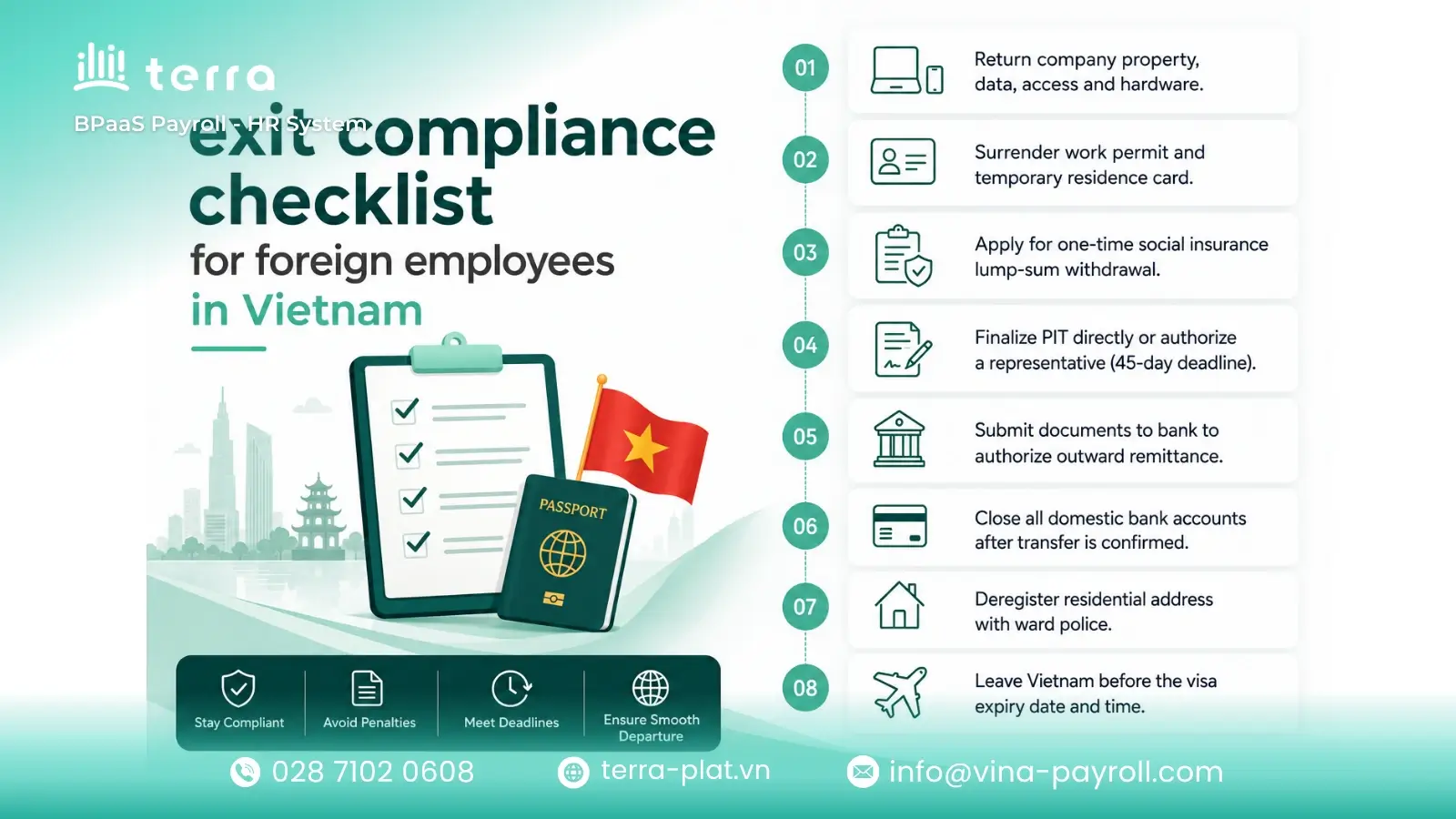
Use these two checklists to run a clean offboarding. They reflect the framework current through 2026, including Decree 219/2025 and the Law on Social Insurance 2024. Each side has tasks that depend on the other, so coordinate dates between HR, legal and accounting.
Employer responsibilities
- Draft and sign the termination agreement, detailing all financial settlements, effective dates and mutual waivers.
- Pay final salary, pro-rated annual leave and statutory severance within the 14 working-day window (Article 48, Labor Code 2019).
- Finalize the compulsory social insurance data and close the social insurance book; the book is now issued within 5 working days under the Law on Social Insurance 2024.
- Confirm the employee’s eligibility for the one-time social insurance claim for foreigners, and hand over the finalized book so they can file the lump-sum claim.
- Issue a certificate of tax deduction for the current tax year.
- Confiscate the original work permit and file the revocation dossier within 15 days of termination under Decree 219/2025/ND-CP; secure the confirmation receipt.
- Confiscate the original temporary residence card and submit it to the Immigration Department; process the 14 days exit visa on the employee’s behalf.
- Archive all termination documents, revocation receipts and transfer records for future state audits.
Employee responsibilities
- Return all company property, data, access credentials and hardware on or before the final working day.
- Surrender the original work permit and temporary residence card to HR or legal.
- File the dossier for the one-time social insurance lump-sum withdrawal with the local social insurance agency; the request can be lodged up to 30 days before contract or permit expiry.
- Complete PIT finalization directly, or sign a notarized power of attorney so a representative can finalize after departure (45-day deadline).
- Submit the contract, termination decision, tax receipts and work permit revocation confirmation to the bank to authorize the outward remittance.
- Close all domestic bank accounts once the international transfer is confirmed.
- Coordinate with the landlord to deregister the residential address with the ward police.
- Leave Vietnam before the exact expiry date and time printed on the exit visa.
Deadline summary at a glance
Every deadline below runs from the official termination or departure date. Confirm each against the current rule before you rely on it, as thresholds are periodically updated.
| Action | Deadline | Legal basis |
|---|---|---|
| Final pay settlement | 14 working days (30 in defined cases) | Article 48, Labor Code 2019 |
| Social insurance book issuance | 5 working days | Law on Social Insurance 2024 |
| Work permit revocation filing | 15 days | Decree 219/2025/ND-CP |
| SI lump-sum claim request | Up to 30 days before expiry; settled in 10 working days | Law on Social Insurance 2024 / Decree 143/2018 |
| Exit visa validity | About 14 days | Law on Entry, Exit, Transit and Residence |
| PIT finalization | 45 days from departure | Law on Tax Administration |
Streamline Your One-Time Social Insurance Claim in Vietnam with terra
If your company is offboarding foreign talent or you are an expat preparing to leave Vietnam, terra’s One-Time Social Insurance Claiming Service ensures a fast, secure, and hassle-free withdrawal process:
- 100% Remote Process: No need to return to Vietnam. Simply provide a legal authorization, and terra will handle all procedures end-to-end from abroad.
- Full Legal Compliance: Backed by over 21 years of FDI consulting experience, our experts meticulously audit your eligibility and documents according to Decree No. 143/2018/NĐ-CP.
- Multilingual Support: Eliminate language barriers with dedicated consultants fluent in English and Japanese.
- Transparent Fee Structure: Enjoy clear, upfront contracts with zero hidden costs, along with continuous tracking until your payout is successfully received.
For FDI subsidiaries that prefer to focus on commercial operations rather than building in-house Vietnamese payroll and compliance capability, terra operates a BPaaS payroll solution and HR platform built specifically for FDI in Vietnam. terra is operated by Vina Payroll Outsourcing (VPO), a member of the I-GLOCAL Japan group.
Conclusion
The exit procedures for foreign employees in Vietnam are a multi-agency legal event with inflexible deadlines across labor, immigration, tax and foreign-exchange rules. Under the 2026 framework, a delay in revoking a work permit or an incomplete PIT finalization does more than trigger a fine; it can suspend the company’s right to sponsor foreign talent.
Build the offboarding protocol around the deadline table above, coordinate HR, legal and accounting from day one, and treat the one-time social insurance claim as a benefit the departing worker should not lose. For the social insurance step, terra runs the full process so nothing slips.